 English
 Spanish
 French
 German
 Italian
 Chinese (Simplified)
 Japanese
 Korean
 Arabic
 Portuguese
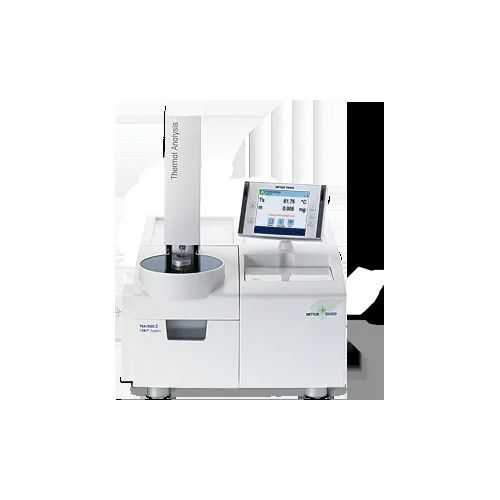
Simultaneous Thermal Analysis (TGA/DSC)
Product Details:
- Model No TGA/DSC STA1600
- Temperature Range Room Temperature to 1600C
- Measurement Range 0.01 mg to 400 mg
- Automation Grade Semi-automatic
- Feature Accurate TGA and DSC measurements, real-time data acquisition, programmable heating rates, high stability
- Accuracy 0.1 C (Temperature), 0.01 mg (Mass)
- Core Components Furnace, balance system, controller, data acquisition system
- Click to View more
Simultaneous Thermal Analysis (TGA/DSC) Product Specifications
- 30/60/110/150/250/350/400/500 gm
- Simultaneous Thermal Analysis
- 50 Hz
- 220 V
- Furnace, balance system, controller, data acquisition system
- Electric
- 490 mm x 380 mm x 420 mm
- Accurate TGA and DSC measurements, real-time data acquisition, programmable heating rates, high stability
- 0.1 C (Temperature), 0.01 mg (Mass)
- Semi-automatic
- 0.01 mg to 400 mg
- Digital
- Approximately 60 kg
- TGA/DSC STA1600
- Room Temperature to 1600C
- High-grade anticorrosive materials & high temperature-resistant alloys
- Laboratory, material characterization & research applications
- Windows-based proprietary software with advanced analysis features
- 500 mg
- Inert, oxidizing, reducing and static/dynamic possible
- USB/Ethernet
- Over-temperature protection, automatic gas switching, furnace overcurrent and leakage protection
- Platinum RTD
- Internal forced air / optional water cooling
- 0.01 mg
- 15C to 40C; 2080% RH (non-condensing)
- Platinum, alumina, ceramics available
- 0.1 to 80C/min
- <1 W
Simultaneous Thermal Analysis (TGA/DSC) Trade Information
- Central America, Australia, Middle East, Eastern Europe, South America, Asia, Western Europe, North America, Africa
- All India
Product Description
Simultaneous Thermal Analysis (TGA/DSC)
The TGA/DSC 3+ provides trustworthy results using a TGA balance from the worldwide leader in weighing technology with position-independent weighing, automatic internal calibration weights, a wide measurement range, the best minimum weight performance and the highest weighing accuracy and precision.It allows users to analyze a wide variety of sample types up to 1600 Deg C.
A complementary DSC heat flow sensor simultaneously detects thermal events such as melting and crystallization in addition to providing accurate and precise transition temperatures.
FAQ
1. What is Simultaneous Thermal Analysis (STA)?
Answer: Simultaneous Thermal Analysis (STA) is a technique that combines several thermal analysis techniques, such as differential scanning calorimetry (DSC), thermogravimetric analysis (TGA), and thermomechanical analysis (TMA), in order to measure the thermal properties of a material.
2. How is STA conducted?
Answer: STA is conducted by placing a sample into an instrument and heating it while simultaneously measuring the thermal properties of the sample. By plotting the data from the instrument, it is possible to gain insight into the thermal behavior of the sample.
3. What are the benefits of using STA?
Answer: The main benefit of using STA is that it allows researchers to gain a more comprehensive understanding of the thermal properties of a material. Additionally, STA can be used to identify the thermal behavior of materials at different stages of their life cycle, such as during manufacturing, storage, or use.
4. What types of materials can be analyzed using STA?
Answer: STA can be used to analyze a wide variety of materials, such as polymers, pharmaceuticals, food products, minerals, ceramics, composites, and metals.
Comprehensive Temperature and Atmosphere Control
The TGA/DSC STA1600 enables simultaneous thermogravimetric and differential scanning calorimetric analysis across a broad temperature range (room temperature to 1600C). Its flexible detection atmospheres allow for inert, oxidizing, reducing, and static or dynamic conditions, ensuring adaptability for various material characterization needs.
Versatile Sample Handling and Robust Construction
This thermal analyzer comes with a selection of crucible materials such as platinum, alumina, and ceramics, suitable for diverse samples. Constructed from high-grade anticorrosive and high temperature-resistant alloys, it ensures longevity and safe operation, making it ideal for rigorous laboratory environments.
Advanced Data Acquisition and User-friendly Software
The system features a digital display, advanced data acquisition via USB/Ethernet, and is operated through proprietary Windows-based software. Researchers benefit from real-time data processing, programmable heating profiles, and enhanced result analysis, optimizing workflows and data accuracy.
FAQs of Simultaneous Thermal Analysis (TGA/DSC):
Q: How does the TGA/DSC STA1600 ensure precise temperature and mass measurements?
A: The TGA/DSC STA1600 utilizes a highly accurate platinum RTD sensor for temperature with 0.1C accuracy and measures mass changes with a precision of 0.01 mg, ensuring reliable and reproducible results during thermal analysis.Q: What types of gas atmospheres can be utilized during simultaneous TGA/DSC analysis?
A: This equipment supports a range of detection atmospheres including inert, oxidizing, reducing, and both static and dynamic modes, allowing users to tailor conditions for specific analytical requirements.Q: When is it advantageous to use different crucible materials for sample analysis?
A: Crucible material choice (platinum, alumina, or ceramics) depends on sample reactivity, temperature requirements, and chemical compatibility, optimizing measurement accuracy and preventing sample contamination.Q: Where can the TGA/DSC STA1600 be installed and operated?
A: The STA1600 is suitable for laboratories or research facilities with controlled environments (15C to 40C temperature and 2080% non-condensing RH) and requires a 220 V power source. Its compact dimensions and robust build ease integration into existing setups.Q: What is the process for data acquisition and analysis with this system?
A: Data collection is facilitated through USB or Ethernet interfaces, while proprietary Windows-based software provides real-time data acquisition, advanced analysis, and the ability to program heating rates and experimental conditions.Q: How does the systems safety features benefit everyday laboratory operations?
A: The analyzer includes over-temperature protection, automatic gas switching, and both furnace overcurrent and leakage protection mechanisms, enhancing operational safety and protecting both users and equipment.Q: What are the primary benefits of simultaneous TGA/DSC measurements in material characterization?
A: Conducting TGA and DSC simultaneously provides comprehensive insight into thermal stability, composition, phase transitions, and reaction kinetics, streamlining experimental workflows and improving the quality of research data.
Price:
- 50
- 100
- 200
- 250
- 500
- 1000+

Other Products in 'Analytical Instruments' category

GST : 27AABCM0779N1Z0

- Amar Hill, Saki Vihar Road, Powai,Mumbai - 400072, Maharashtra, India
- Phone : 08045816537
- Ms Ekta Zemse (Executive Marketing)
- Mobile : 08045816537
-
 Send Inquiry
 Send Inquiry
|


 |
Mettler-Toledo India Private Limited
All Rights Reserved.(Terms of Use) Developed and Managed by Infocom Network Private Limited. |
