 English
 Spanish
 French
 German
 Italian
 Chinese (Simplified)
 Japanese
 Korean
 Arabic
 Portuguese
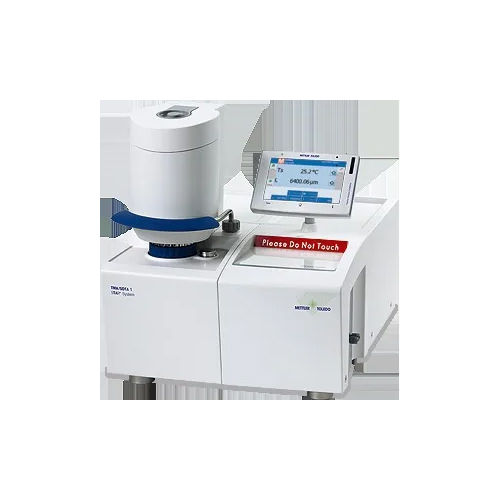
Thermomechanical Analysis (TMA)
Product Details:
- Voltage 230 V AC
- Feature High Precision, User Friendly
- Core Components Sample holder, Heating system, Probe, Controller
- Capacity 1 gm 10 gm
- Power Source Electric
- Measurement Range Up to 2 mm
- Frequency 50 Hz
- Click to View more
Thermomechanical Analysis (TMA) Product Specifications
- 335 x 310 x 340 mm
- Thermomechanical Analyzer
- TMA-2650
- Laboratory
- 20 kg
- Ambient to 600C
- 0.1C
- Semi-Automatic
- 50 Hz
- Electric
- Up to 2 mm
- 1 gm 10 gm
- Digital
- Sample holder, Heating system, Probe, Controller
- High Precision, User Friendly
- Mild Steel
- 230 V AC
- Air cooled
- <85% RH non-condensing
- Windows-based data analysis software
- Flat, hemispherical, penetration
- Up to 10 mm length
- 0.1 to 20°C/min selectable
- USB and RS232 interfaces
- Over-temperature cut-off
- 0.01 µm
- 200 W
Thermomechanical Analysis (TMA) Trade Information
- Western Europe, Central America, Australia, North America, Middle East, Eastern Europe, Asia, South America, Africa
- All India
Product Description
Thermomechanical Analysis (TMA)
Precise Determination of Coefficients of Thermal Expansion (CTEs) and Transitions
The TMA/SDTA 2+ can be used for a wide range of applications due to its broad temperature range and the wide choice of force parameters in compression and tension modes. As a result, the TMA/SDTA 2+ quickly provides characteristic information on numerous types of samples, for example very thin layers, large sample cylinders, fine fibers, films, plates, soft or hard polymers, and single crystals.
Thermo mechanical analysis (TMA) is the ideal addition to DSC. Besides the measurement of expansion coefficients, TMA is also an excellent technique for determining glass transitions that cannot be satisfactorily measured by DSC, for example materials with a high filler content. The penetration mode is ideal for characterizing the glass transitions of difficult samples such as very thin coatings.
FAQ
1. What is Thermomechanical Analysis (TMA)?
Answer: Thermomechanical Analysis (TMA) is a type of laboratory testing which studies the effects of temperature and force on materials. It is used to measure the thermal expansion and contraction, mechanical properties, and thermal conductivity of a material.
2. What are the advantages of TMA?
Answer: TMA provides a wide range of information on a materials properties, including its temperature-dependent behavior and its response to applied forces. It can be used to analyze the effects of different materials and treatments on the materials mechanical and thermal characteristics, helping researchers and engineers to optimize designs.
3. What are the limitations of TMA?
Answer: TMA is limited by its reliance on laboratory testing, which can be costly and time-consuming. Additionally, the results of TMA tests may be affected by the environment and the test conditions, so results may not always be reliable.
4. What types of materials can be tested with TMA?
Answer: TMA can be used to test a wide range of materials, including metals, polymers, ceramics, and composites. It can also be used to study the behavior of materials under extreme temperature and pressure conditions.
Accurate and Versatile Thermomechanical Analysis
The TMA-2650 delivers exceptional accuracy (0.1C) in measuring thermal expansion and related properties. It accommodates various probe typesincluding flat, hemispherical, and penetrationmaking it well-suited for different material types and forms. Designed for laboratories, it ensures comprehensive thermal characterization.
User-Friendly Design and Robust Features
With a digital display, semi-automatic controls, and intuitive Windows software compatibility, users benefit from an efficient workflow. The inclusion of air cooling, over-temperature cut-off, and easily selectable measurement ranges ensures precise and safe operation. The unit is engineered for reliability with sturdy mild steel construction.
FAQs of Thermomechanical Analysis (TMA):
Q: How is the TMA-2650 Thermomechanical Analyzer used in laboratory settings?
A: The TMA-2650 is used for measuring the dimensional changes of materials as they are subjected to controlled temperature variations. This aids in assessing thermal expansion, softening, and other physical changes, which are key for material research and quality assurance.Q: What probe types are compatible with the TMA-2650, and how do they benefit various applications?
A: The analyzer supports flat, hemispherical, and penetration probes. Each probe type enables precise analysis of different material behaviorsflat probes for general expansion, hemispherical for softening, and penetration for strength under heat, thus broadening its applicability.Q: When should the over-temperature cut-off feature be utilized?
A: The over-temperature cut-off protects both samples and instrument. It automatically triggers if the internal temperature exceeds preset safe values, which is essential during extended or high-temperature experiments to prevent damage and ensure user safety.Q: Where can data from the TMA-2650 be exported and analyzed?
A: Data collected from experiments can be exported through USB or RS232 interfaces. The analyzer is compatible with Windows-based data analysis software, allowing users to easily store, visualize, and interpret results on standard laboratory computers.Q: What are the sample size and weight limits for analysis with this device?
A: The TMA-2650 can handle samples up to 10 mm in length and a weight capacity ranging from 1 gram to 10 grams, accommodating a variety of solid materials commonly analyzed in laboratories.Q: How does the TMA-2650 ensure high measurement precision?
A: The device features a high-resolution sensor with 0.01 m resolution and an accuracy of 0.1C, supported by a well-calibrated controller. These features enable detection of minute dimensional changes, critical for research and quality testing.
Price:
- 50
- 100
- 200
- 250
- 500
- 1000+

Other Products in 'Analytical Instruments' category

GST : 27AABCM0779N1Z0

- Amar Hill, Saki Vihar Road, Powai,Mumbai - 400072, Maharashtra, India
- Phone : 08045816537
- Ms Ekta Zemse (Executive Marketing)
- Mobile : 08045816537
-
 Send Inquiry
 Send Inquiry
|


 |
Mettler-Toledo India Private Limited
All Rights Reserved.(Terms of Use) Developed and Managed by Infocom Network Private Limited. |
