 English
 Spanish
 French
 German
 Italian
 Chinese (Simplified)
 Japanese
 Korean
 Arabic
 Portuguese
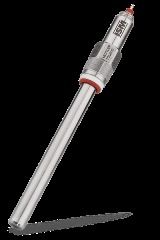
Amperometric Sensor for Gas-Phase Oxygen
Product Details:
- Accuracy 2% of full scale
- Operating Voltage 12 V DC
- Humidity 0 to 95% RH, Non-condensing
- Frequency Continuous Monitoring
- Number of Specimens Single
- Automation Grade Semi-Automatic
- Max Height 52 mm
- Click to View more
Amperometric Sensor for Gas-Phase Oxygen Product Specifications
- Single
- Continuous Monitoring
- 0 to 95% RH, Non-condensing
- 2% of full scale
- 12 V DC
- Industrial, Laboratory
- Semi-Automatic
- DC 12 V
- 52 mm
- Amperometric Oxygen Sensor
- Adjustable (0.5 5 L/min)
- 0 100% O
- High Sensitivity, Low Drift, Compact Design
- Microcontroller Based
- 120 g
- Panel or Inline Mount
- Max 2 bar
- 0 100% Oxygen
- <10 seconds
- Analog Output
- 0 to 50C
- Gas-phase Oxygen Measurement
- 0.1% Oxygen
- 6 mm Push-In Fitting
- Digital LCD
- 1 meter standard
- -20C to 60C
- 6 months recommended
- Electrochemical (Amperometric)
- ABS / Polycarbonate
- IP65
- RoHS, CE Marked
- <5 min
- >24 months under normal conditions
- 420 mA or 010 V
Amperometric Sensor for Gas-Phase Oxygen Trade Information
- Central America, Eastern Europe, Middle East, South America, Asia, Western Europe, North America, Australia, Africa
- All India
Product Description
Amperometric Oxygen Gas Sensors
A tool used to gauge the amount of oxygen (O2) in a gas stream is an amperometric sensor for gas-phase oxygen. It operates by electrochemically determining how much oxygen is reduced at the electrode surface.
The amperometric sensor normally consists of a counter electrode made of a conductive material, such as graphite, and a sensing electrode made of a material that catalyses the reduction of oxygen, such as platinum or gold. The decrease of oxygen at the sensing electrode produces a current that the sensor measures after applying a voltage between the two electrodes. The quantity of current produced is inversely proportional to the oxygen content of the gas stream.
Amperometric sensors for gas-phase oxygen provide great sensitivity and accuracy as a benefit. They are capable of measuring a wide range of concentrations, from trace quantities to almost 100% oxygen, and can detect oxygen concentrations as low as parts per billion (ppb). They are also simple to use and reasonably priced.
In industrial and laboratory contexts, amperometric sensors for gas-phase oxygen are frequently used to track oxygen levels in processes including gas storage, fermentation, and combustion. They are also utilised in medical procedures to check patients' oxygen levels, including respiratory treatment and anaesthesia.
It is important to keep in mind that amperometric sensors might lose accuracy due to their sensitivity to other gases and environmental variables, such as temperature and humidity. As a result, accurate calibration and maintenance are crucial to ensuring dependable and accurate results.
Oxygen control for your gas applications
- In process gas stream or tank applications, amperometric oxygen gas sensors provide reliable, real-time measurements without the need for gas sampling or conditioning.
- Easy in-situ installation directly in the tank or vessel
- No cumbersome sampling system needed
- Easy two-minute maintenance and calibration
FAQ
1. How does a gas-phase oxygen amperometric sensor function?
Ans - When oxygen molecules interact with a catalyst, an amperometric sensor for gas-phase oxygen measures the current that is produced. The amount of oxygen in the gas phase can be measured by measuring the current produced.
2. What are the benefits of utilising an amperometric oxygen sensor in the gas phase?
Ans - The accuracy and capability to detect extremely low oxygen concentrations are two benefits of utilising an amperometric sensor for gas-phase oxygen. It is also very sensitive and has a simple calibration process.
3. What kinds of components go into making an amperometric sensor for gas-phase oxygen?
Ans - A base metal electrode, a catalytic substance, and an electrolyte solution are commonly employed in the fabrication of an amperometric sensor for gas-phase oxygen.
4. What is the amperometric sensor's gas-phase oxygen detection range?
Ans - Depending on the type of sensor being used, an amperometric sensor for gas-phase oxygen can have a range that varies, but is normally between 0 and 100% oxygen concentration.
5. How frequently should a gas-phase oxygen amperometric sensor be calibrated?
Ans - To ensure accuracy, an amperometric sensor for gas-phase oxygen should be calibrated at least once a year.
Reliable and Accurate Oxygen Measurement
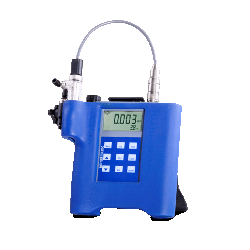
This sensor delivers high-precision gas-phase oxygen detection, with 2% full-scale accuracy and a resolution of 0.1% O. The microcontroller-based control, adjustable test speed (0.55 L/min), and digital LCD display ensure both accuracy and ease of operation for users in industrial or laboratory settings.
Designed for Versatile Installation
With its compact, robust body (ABS/polycarbonate) and panel or inline mounting options, the sensor suits a variety of workplaces. The IP65 protection rating allows for installation in environments where dust and water ingress protection are required, ensuring long-lasting performance.
Efficient Operation and Maintenance
Requiring less than 5 minutes for warm-up and only periodic calibration every 6 months, the sensor minimizes downtime. The 1-meter standard cable and 6 mm push-in fitting make setup straightforward, and continuous monitoring is supported for automation or manual testing.
FAQs of Amperometric Sensor for Gas-Phase Oxygen:
Q: How do I install the Amperometric Oxygen Sensor in my setup?
A: Installation is straightforward with panel or inline mounting options and a 1-meter cable as standard. Connect the sensor using the 6 mm push-in fitting and ensure the power supply is 12 V DC. The analog output (420 mA or 010 V) can be linked to your monitoring or control system.Q: What process should I follow to calibrate the sensor?
A: Its advised to calibrate the sensor every 6 months. Use standard calibration gases within the 0100% O measurement range. Follow the calibration procedure as outlined in the user manual to ensure accurate readings and optimal sensor lifespan.Q: When does the sensor require recalibration or maintenance?
A: A recommended calibration interval is every 6 months under normal operating conditions. Regular maintenance includes visual checks for damage and periodic cleaning, if necessary, to maintain stable performance.Q: Where can this oxygen sensor be applied?
A: The sensor is suitable for industrial workspaces, laboratories, and automation setups where reliable oxygen monitoring is essential. Its IP65 rating protects against dust and water, making it versatile for installation in various environments.Q: What are the main benefits of using this amperometric sensor?
A: Key benefits include high sensitivity, rapid response time (<10 seconds), low drift, and a robust, compact design. The sensor supports continuous monitoring, offers flexible analog outputs, and has a long expected operational life (>24 months), reducing the need for frequent replacement.Q: How does the sensor output oxygen measurements?
A: Oxygen measurements are output as either a 420 mA current loop or a 010 V voltage signal. The digital LCD display also provides real-time O readings, making it easy to monitor both on-site and remotely.
Price:
- 50
- 100
- 200
- 250
- 500
- 1000+

Other Products in 'Process Analytics' category

GST : 27AABCM0779N1Z0

- Amar Hill, Saki Vihar Road, Powai,Mumbai - 400072, Maharashtra, India
- Phone : 08045816537
- Ms Ekta Zemse (Executive Marketing)
- Mobile : 08045816537
-
 Send Inquiry
 Send Inquiry
|


 |
Mettler-Toledo India Private Limited
All Rights Reserved.(Terms of Use) Developed and Managed by Infocom Network Private Limited. |
