 English
 Spanish
 French
 German
 Italian
 Chinese (Simplified)
 Japanese
 Korean
 Arabic
 Portuguese
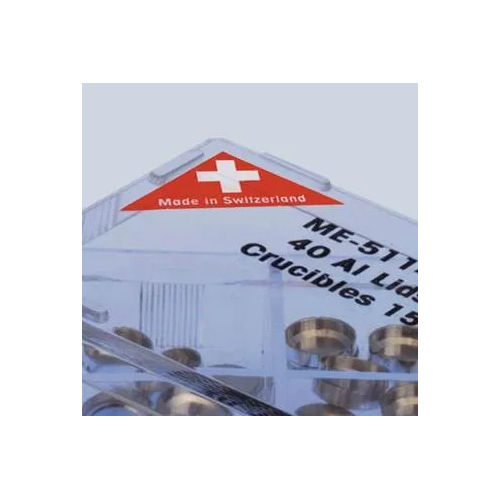
Thermal Analysis Crucibles
Product Details:
- Automation Grade Applicable for manual or automated thermal analysis equipment
- Accuracy High sample integrity for precise thermal measurements
- Temperature Range Ambient to 1600C
- Core Components Crucible body
- Measurement Range Designed for trace to bulk sample measurements
- Feature High temperature resistance, chemical inertness, minimal thermal expansion
- Capacity 30 - 80 L
- Click to View more
Thermal Analysis Crucibles Product Specifications
- 5mm x 5mm x 10mm to 10mm x 10mm x 20mm
- Crucible body
- Thermal analysis (DSC, TGA, DTA, STA)
- Ambient to 1600C
- High sample integrity for precise thermal measurements
- Applicable for manual or automated thermal analysis equipment
- Analog / Digital (Depending on instrument compatibility)
- 30 - 80 L
- TA-CRU-ALU / TA-CRU-PT / TA-CRU-ZR (varies by material)
- High temperature resistance, chemical inertness, minimal thermal expansion
- Thermal Analysis Crucible
- Alumina, Platinum, Zirconia, Ceramic
- Designed for trace to bulk sample measurements
- Approx. 0.5g - 2g per crucible
- Phase determination, decomposition studies, melting/boiling point analysis
- White (alumina/ceramic), Metallic (platinum/zinc)
- Optimal for fast heat transfer
- Available as single-use or reusable types depending on material
- Concave, pan, and flat bottom forms
- Compatible with most thermal analyzers (DSC, TGA, DTA)
- Smooth inner surface for uniform heat distribution
- ISO certified process
- Pack of 20 / 50 / 100 crucibles
- Atmospheric pressure
- Dry environment, room temperature
- Excellent resistance to acids and alkalis
- Typically 10 - 80 µL
Thermal Analysis Crucibles Trade Information
- Australia, Central America, South America, Western Europe, Middle East, Eastern Europe, Asia, North America, Africa
- All India
Product Description
Thermal analysis crucibles are containers made of materials that can withstand high temperatures, used to hold and heat samples during thermal analysis experiments. Thermal analysis techniques such as differential scanning calorimetry (DSC), thermogravimetric analysis (TGA), and thermal conductivity measurements require precise control of the temperature and environment in which the sample is held. Crucibles play a critical role in achieving this control. Crucibles used for thermal analysis are typically made from materials that can withstand high temperatures without melting, degrading, or reacting with the sample being analyzed. Common materials used include alumina, platinum, quartz, and ceramic composites. The choice of crucible material depends on the type of analysis being performed and the properties of the sample being analyzed.
In addition to material selection, other factors such as crucible size and shape, lid type, and sealing mechanism can also affect the accuracy and precision of thermal analysis experiments. Proper handling and preparation of the crucible, such as cleaning and preheating, can also be critical for obtaining reliable results.
Thermal Analysis Crucibles:-
- METTLER TOLEDO offers a wide variety of crucibles that serve as sample containers for thermo analytical measurements.
- Select the right crucible type - and improve your measurement quality
- The type of crucible used for a measurement can have a significant effect on the quality of the results obtained and can also influence important characteristics of the DSC measuring cell.
FAQ
1. What are thermal analysis crucibles used for?
Answer: Thermal analysis crucibles are used for analyzing and measuring the thermal properties of materials in a wide range of applications. They are commonly used for testing the thermal stability of materials, as well as for measuring the thermal diffusivity of materials.
2. How do thermal analysis crucibles work?
Answer: Thermal analysis crucibles are usually made of a material that can withstand high temperatures and conduct heat well. Heat is applied to the crucible and the sample material is placed inside. The temperature change of the material is then measured over a given period of time.
3. What types of materials can be tested with thermal analysis crucibles?
Answer: Thermal analysis crucibles can be used to test a wide variety of materials, including metals, ceramics, plastics, and composites.
4. How do I choose the right thermal analysis crucible for my application?
Answer: The choice of thermal analysis crucible will depend on the type of material being tested, as well as the temperature range that needs to be tested. It is important to choose a crucible that is compatible with the sample material, and that can withstand the maximum temperature range. It is also important to consider the thermal expansion rate of the crucible material, as this will affect the accuracy of the results.
Versatile Design & Exceptional Chemical Resistance
Our crucibles support multiple bottom shapesconcave, pan, and flataccommodating diverse sample types and experimental needs. Materials such as alumina, platinum, and zirconia guarantee outstanding chemical inertness and stability, even with aggressive acids and alkalis.
Optimized for High-Precision Thermal Analysis
Designed for applications including phase determination, decomposition, and melting/boiling point analysis, these crucibles feature optimal thermal conductivity and a smooth finish. This ensures efficient, uniform heating and accurate, repeatable results.
Flexible Usage and Broad Compatibility
Available as both single-use and reusable options, they are compatible with most thermal analyzers (DSC, TGA, DTA, STA). With standard sizing, color coding, and packaging in units of 20, 50, or 100, these crucibles meet the demands of dealers, manufacturers, and research facilities alike.
FAQs of Thermal Analysis Crucibles:
Q: How do I select the appropriate crucible shape and material for my thermal analysis application?
A: Choose the crucible shape (concave, pan, or flat bottom) based on your sample type and analysis requirements. Alumina and platinum are excellent for high-temperature and chemically aggressive environments, while ceramic and zirconia suit general thermal measurements and work with most analyzers.Q: What is the recommended process for preparing and storing these crucibles?
A: Before use, ensure the crucible is thoroughly cleaned and completely dry. Store them in a dry, room-temperature environment to prevent moisture absorption and contamination, adhering to ISO-certified laboratory procedures.Q: When should I use a disposable versus a reusable crucible?
A: Disposable crucibles are ideal for applications prone to contamination or where sample integrity is critical. Reusable crucibles are suitable for routine laboratory analyses with stable, clean samples, reducing overall operational costs.Q: Where can these thermal analysis crucibles be used and with which instruments?
A: They are compatible with most standard thermal analysis equipment, including DSC, TGA, DTA, and STA, and are widely used in research institutes, pharmaceutical labs, and industrial quality control settings.Q: What benefits do the smooth inner surface and high thermal conductivity offer?
A: A smooth inner surface promotes uniform heat distribution, while high thermal conductivity ensures rapid, consistent heat transfer. This combination results in precise temperature control and high sample integrity, enabling accurate thermal measurements.Q: How much sample volume can each crucible accommodate, and in what range of temperatures can it operate?
A: Each crucible typically accommodates 1080 L (with some models offering 3080 L) and can withstand temperatures from ambient up to 1600C. This caters to a wide range of sample sizes and thermal analysis demands.
Price:
- 50
- 100
- 200
- 250
- 500
- 1000+

Other Products in 'Analytical Instruments' category

GST : 27AABCM0779N1Z0

- Amar Hill, Saki Vihar Road, Powai,Mumbai - 400072, Maharashtra, India
- Phone : 08045816537
- Ms Ekta Zemse (Executive Marketing)
- Mobile : 08045816537
-
 Send Inquiry
 Send Inquiry
|


 |
Mettler-Toledo India Private Limited
All Rights Reserved.(Terms of Use) Developed and Managed by Infocom Network Private Limited. |
